


Apskats
Īss, Eiropai veltīts apskats par MI juridiskajā praksē. Pierādījumu līmeņi, jurisdikcijas konteksts un avotu saites katrā izdevumā.
2026. gada 25. aprīlis
When the Models Get Better, Does the Problem Go Away?
Sullivan & Cromwell — the firm that advises OpenAI on the safe deployment of AI — just filed a Chapter 15 emergency motion riddled with AI hallucinations. Liga reads the apology letter and asks: if better models still produce undetectable errors, what is actually broken? Four bets companies are making, one structural question, and why the simulator is still missing.
2026. gada 15. aprīlis
Why We Added a Seventh Pillar: AI Decision Boundaries
We added a seventh pillar to the Twin Ladder Standard — AI Decision Boundaries — because the gap between policy and execution kept showing up in our assessments. ING and ABN Amro automating AML decisions; vendors pre-filtering choices before humans see them. The other six pillars do not catch this. The seventh does.

2026. gada 29. marts
The Governance You Didn't Delegate: When Your SaaS Vendor Makes Decisions Before You See Them
Most organisations believe they have AI governance because they have policies, training, and monitoring. But none of those things can answer the question that actually matters in enforcement: when your AI system executed that action — was it allowed to? We introduce three governance models, expose the vendor pre-filtering problem, and ask whether opaque SaaS systems are structurally non-compliant under Article 4.

2026. gada 28. marts
Marketing's AI Compliance Blind Spot: When the Heaviest AI Adopter Can't Verify What It Publishes
Marketing teams account for 35% of enterprise generative AI spend — more than any other function. Yet fabricated statistics, hallucinated sources, and unverified regulatory claims are reaching audiences daily. We examine the layered exposure across GDPR, DSA, and the AI Act.
2026. gada 26. marts
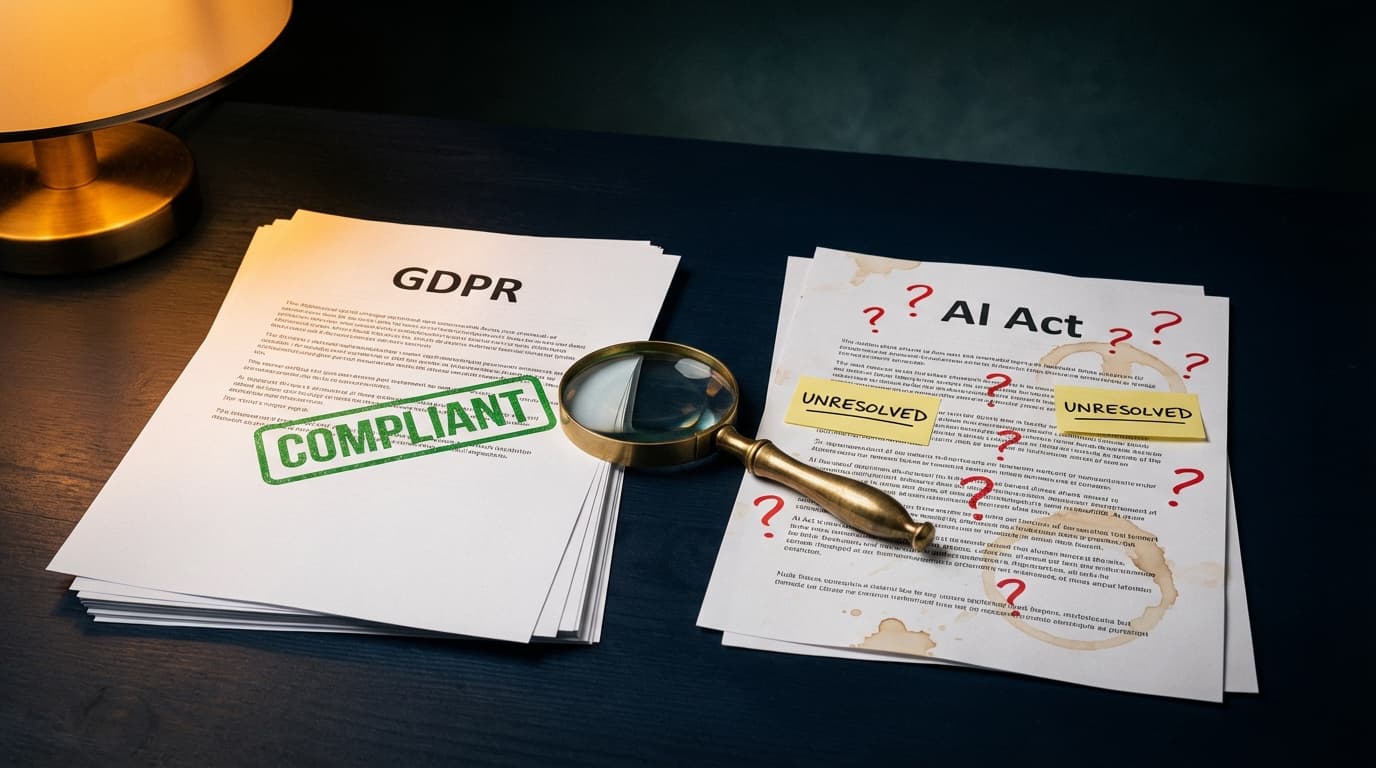
GDPR vs the AI Act: Why Your Compliance Playbook Will Not Work This Time
Three times last week I was asked whether the GDPR programme 'covers' the AI Act. It does not. We examine four fundamental distinctions between guardrail regulation and process transformation — and why Article 4, binding since February 2025, demands competence that cannot be centralised.

2026. gada 21. marts
HR Is Ground Zero for Article 4: Why People Teams Face the Highest AI Compliance Risk
HR teams deploy more high-risk AI systems than any other function — from CV screening to performance prediction. Yet most recruiters cannot explain how their AI shortlisted one candidate over another. We map the exposure across Annex III categories and five European enforcement mechanisms already in motion.

2026. gada 14. marts
When AI Training Isn't Training: The Gap Between What Companies Buy and What Article 4 Requires
The EUR 2.4 billion European AI training market is selling certificates, not competence. We review 31 programmes and find that 87% allocate less than 10% of time to AI limitations and failure modes. Five markers distinguish genuine competence-building from checkbox compliance.

2026. gada 14. marts
The Procurement Blind Spot: When Buying AI Means Buying Compliance Risk
Most companies evaluate AI vendors using traditional software procurement frameworks. But Article 4 places the literacy obligation on the deployer — the buyer — not the seller. We introduce five RFP questions every procurement team should ask and a Vendor Competence Framework for scoring AI suppliers.
Apskatu arhīvs

Izdevums #25
The Competence Paradox Hits Home: When Junior Lawyers Never Learned What AI Is Replacing
2026. gada 14. februāris 19 min lasīšana
Izdevums #24
2026 Legal AI Outlook: Five Evidence-Based Projections for Mid-Market Firms
2026. gada 23. janvāris 21 min lasīšana

Izdevums #23
AI Governance Boards: 80% of Am Law 100 Have One—A Structure Guide
2026. gada 9. janvāris 19 min lasīšana

Izdevums #22
ABA Task Force Report Analysis: AI as Legal Infrastructure
2025. gada 19. decembris 17 min lasīšana

Izdevums #21
Legal AI 2025 in Review: The Year Trust Became Measurable
2025. gada 5. decembris 18 min lasīšana

Izdevums #20
NormAI Launches Norm Law: Second AI-Native Firm Model
2025. gada 21. novembris 18 min lasīšana
Izdevums #19
UK Bar Council AI Guidance Update: Key Changes for Barristers
2025. gada 7. novembris 18 min lasīšana
Izdevums #18
Harvey's $150M Extension at $8B: Third Raise in 18 Months
2025. gada 17. oktobris 17 min lasīšana
Pievienojieties iknedēļas apskatam un saņemiet pārbaudes piezīmes katrā izdevumā.