

"94% Not Ready" --- Germany's Mittelstand and the Industry 4.0 Paradox
Twin Ladder Casebook | IdeaJetLab | February 2026
The Hook
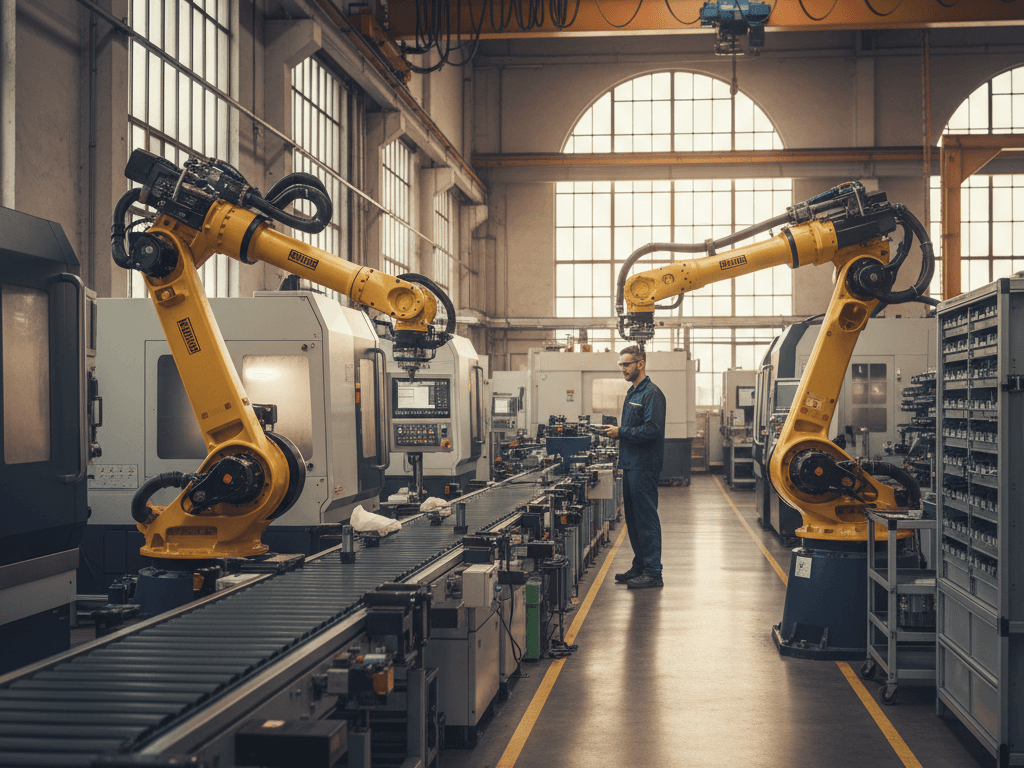
Walk through a Mittelstand factory in Baden-Wurttemberg and the scene is formidable. Robotic arms weld chassis components with sub-millimeter precision. IoT sensors on every stamping press feed real-time vibration data into dashboards that glow with green status indicators. Predictive maintenance alerts flash before a bearing has even begun to degrade. The production line hums with the quiet authority of German engineering at its finest. This is Industry 4.0 --- the vision that Germany not only coined but exported to the world.
Then ask the plant manager a simple question: "What does your AI strategy look like?"
Silence. A long pause. Perhaps a reference to a pilot project that ran for three months in 2024 and was never scaled. Perhaps a mention of ChatGPT subscriptions that a few engineers use on their own initiative. Perhaps an honest admission: "We know we need to do something. We do not know where to start."
That silence is not an aberration. It is the norm. According to a 2025 industry analysis by Dr Justus and Partners, which synthesized peer-reviewed academic and industry research published between 2020 and 2025, ninety-four percent of German Mittelstand firms have yet to implement AI in operational practice. Germany invented the smart factory. It has not yet figured out what to do with the intelligence.
The Story
The numbers describe a paradox that would be comical if the economic stakes were not so severe.
Germany is the country that gave the world the term "Industrie 4.0." Nine out of ten German manufacturing companies currently use or plan to use Industry 4.0 applications, according to Bitkom. The German robotics and automation industry generated an estimated 16.5 billion euros in turnover in 2024. Siemens operates a factory in Amberg with a production quality rate of 99 percent, achieved through comprehensive IoT integration. The infrastructure is world-class. The data is flowing. The sensors are sensing.
And yet only six percent of Mittelstand firms have moved beyond experimentation to operational AI deployment.
The reasons are structural, cultural, and --- most critically --- human.
The talent deficit is severe. Germany faces a shortage of approximately 137,000 IT specialists, according to Bitkom research, and demand for AI-related competencies continues to climb. More recent estimates from 2025 place the figure at 109,000 unfilled positions, but even the lower number represents a crisis for an economy that depends on its engineering workforce. Over sixty percent of German SMEs cite missing employee skills as their primary obstacle to AI adoption. The Mittelstand, which employs roughly sixty percent of the German workforce, cannot recruit its way out of this gap. The specialists it needs are being absorbed by large technology companies in Berlin, Munich, and increasingly, outside Germany altogether.
Regulatory paralysis compounds the skills shortage. A majority of German companies --- eighty-two percent --- cite legal uncertainty as a significant barrier to AI adoption. Seventy-three percent point to data protection requirements. Sixty-eight percent identify regulatory hurdles more broadly. These figures exceed those of every other major European economy. Fifty-two percent of German managers report feeling actively restricted by regulation, the highest proportion in any country surveyed. The EU AI Act, which entered into force in August 2024, has intensified this anxiety. A Deloitte survey found that fifty-two percent of German businesses worry that AI Act requirements will limit their innovation opportunities, while only thirty-six percent feel prepared for implementation.
The compliance paradox is striking. Research published in the Journal of Next-Generation Research 5.0 found that German small businesses score an impressive 82.24 out of 100 for GDPR familiarity, yet manage only 56.24 out of 100 for AI Act awareness. These firms have become experts at data protection. They have not yet learned the rules of the game that comes next.
Leadership hesitation is the quiet accelerant. The Dr Justus and Partners analysis challenges the prevailing narrative that GDPR and regulatory burden are the primary obstacles. The research identifies leadership hesitation and skills shortages --- not data protection law --- as the dominant barriers. This distinction matters enormously. Regulatory frameworks can be navigated with legal counsel. Leadership hesitation requires a different intervention entirely: it requires executives who understand what AI can and cannot do, who can evaluate vendor claims critically, and who possess the confidence to commit organizational resources to a transformation they themselves do not fully comprehend.
The investment trajectory is moving in the wrong direction. In a survey of 200 Mittelstand firms published in early 2026, management consultancy Horvath found that these companies spent 0.35 percent of their revenues on AI technologies in 2025, down from 0.41 percent in 2024. At precisely the moment when AI capability is accelerating and competitive pressure is intensifying, the Mittelstand is reducing its AI expenditure. This is not prudent caution. It is a retreat.
The result is what practitioners describe as the "data-rich, insight-poor" phenomenon. German manufacturing floors generate extraordinary volumes of operational data --- temperature readings, cycle times, defect rates, energy consumption, supply chain signals --- but that data sits in silos, unanalyzed or under-analyzed, because the human infrastructure to extract meaning from it does not exist. The sensors are working. The intelligence layer is absent.
The global comparison sharpens the urgency. While Germany deliberates, competitors accelerate. The United States and China are deploying AI across manufacturing at rates that make Europe's twenty percent adoption figure look like a rounding error in the context of strategic competition. Microsoft's 2025 Global AI Adoption report found that enterprise AI usage in North America and East Asia is growing at roughly double the European rate, with SME adoption in those regions driven by less restrictive regulatory environments and deeper venture capital ecosystems. South Korea and Japan, countries with manufacturing traditions comparable to Germany's, have integrated AI into production quality control and predictive logistics at a pace the Mittelstand has not matched. The risk is not abstract. It is competitive. If a Chinese manufacturer uses AI-driven quality inspection to achieve defect rates that a German competitor matches only through manual processes at three times the labor cost, the German firm does not lose a technology race. It loses contracts.
Volkswagen offers the counterexample that proves the rule. The company has committed up to one billion euros in AI expansion through 2030 and has already trained over 130,000 employees through its "WE and AI" program, launched in 2024. The program spans every level of the organization, from line workers to board members. More than 1,200 AI applications are active across the Volkswagen Group, with several hundred more in development. The company projects efficiency gains and cost avoidance totaling four billion euros by 2035. But Volkswagen is not the Mittelstand. It has the scale, the capital, and the organizational capacity to build an AI competence infrastructure from the ground up. A family-owned manufacturer in Swabia with 200 employees and a single IT administrator does not.
Through the Twin Ladder Lens
The Twin Ladder framework, introduced in IdeaJetLab's The Competence Paradox (2026), provides a diagnostic lens for understanding exactly where the Mittelstand is stalled --- and why.
The framework defines four levels of organizational AI competence: Level 0 (AI Literacy Foundation), Level 1 (Professional Twin), Level 2 (Operational Twin), and Level 3 (Ecosystem Twin). Each level builds on the one below. The ladder is climbed, not skipped.
The Mittelstand is stalled at the boundary between Level 0 and Level 1. The prerequisites for Level 0 --- baseline data infrastructure, connected systems, sensor networks --- are partially met. German manufacturers have invested heavily in the physical and digital infrastructure of Industry 4.0. The data exists. But Level 0 demands more than data. It demands AI Literacy: the baseline ability to critically assess AI-generated output, to distinguish between a useful recommendation and a plausible hallucination, to understand that an AI inference is not a verified conclusion.
This literacy does not exist at scale in the German Mittelstand. When sixty percent of SMEs cite missing employee skills as their primary barrier, they are describing a Level 0 failure. When eighty-two percent cite legal uncertainty, they are describing leadership that cannot evaluate AI risk because it does not possess the foundational understanding of what AI systems actually do. Regulatory paralysis is not a legal problem. It is a literacy problem. Leaders who understand AI at a functional level do not freeze in the face of regulation. They navigate it.
The bottleneck is not technology. German manufacturers have proven, repeatedly, that they can deploy sophisticated technology. The bottleneck is leadership capability and organizational readiness --- the human competence infrastructure that the Twin Ladder places at Level 0. Without it, Level 1 is inaccessible. Without Level 1, where individual professionals mirror their roles with AI agents and develop the judgment to evaluate AI output against their own domain expertise, the organization cannot build the competence to operate at any higher level.
The Volkswagen example is instructive precisely because it follows the Twin Ladder sequence. The "WE and AI" program is a Level 0 initiative: literacy training across every organizational layer, from the factory floor to the boardroom. The 1,200 active AI applications represent Level 1 implementations: AI agents working alongside human professionals in specific roles, generating outputs that humans evaluate, challenge, and improve. Volkswagen is climbing the ladder. It started at the bottom.
The Mittelstand has not started climbing. It is standing at the base, looking up, and waiting for someone to build an elevator.
The Pattern
Germany is not alone. The Mittelstand paradox is a European condition.
Eurostat data from 2025 reveals that only twenty percent of EU enterprises with ten or more employees use AI technologies --- a figure that has grown from 13.5 percent in 2024, but remains far below the ambitions expressed in European policy documents. The gap between aspiration and implementation is continent-wide.
France, which leads Europe in developing foundational AI models and hosts some of the continent's most prominent AI research laboratories, saw less than ten percent of its businesses using AI technology in 2024. The country that produced Mistral AI has not yet persuaded its own SME sector to adopt the technology.
The Netherlands presents a particularly instructive case. Ninety-five percent of Dutch organizations report running AI programs --- the highest adoption rate in Europe. Yet forty percent of Dutch companies are not using AI operationally, citing lack of knowledge, safety concerns, and perceived irrelevance. Research indicates that SMEs without digital readiness frameworks were forty-three percent more likely to abandon their AI projects within the first year. The Netherlands' own National AI Delta Plan, presented in late 2025, acknowledged that the country lags in critical dimensions of AI adoption and literacy. Having a program is not the same as having competence.
The Nordic countries --- Denmark at 42 percent adoption, Finland at 38 percent, Sweden at 35 percent --- lead Europe by a significant margin. But even these figures mean that more than half of enterprises in the most digitally advanced economies in Europe have not adopted AI. And the gap between large enterprises (55 percent adoption) and small enterprises (17 percent) persists across every member state.
The most common reason European enterprises give for not adopting AI is the lack of relevant expertise, cited by seventy-one percent of non-adopters across the EU. Fifty-three percent cite lack of clarity about legal consequences. Forty-nine percent cite data protection and privacy concerns. These numbers mirror the German figures almost exactly --- because the German condition is not an outlier. It is the median European experience, expressed with particular clarity because Germany's industrial strength makes the gap between what it could do and what it is doing so visually stark.
The pattern is consistent: ambition without capability, infrastructure without literacy, data without insight. Europe has the regulatory frameworks. It has the research institutions. It has, in Germany's case, the most sophisticated manufacturing base on the continent. What it lacks, systematically, is the human competence layer that transforms AI tools into AI capability. The Fraunhofer ISI finding that only sixteen percent of German industrial firms integrate AI directly into production --- despite decades of automation leadership --- is not a technology failure. It is an organizational one. The machines are ready. The people who must direct them are not.
The Lesson
The Mittelstand's traditional strength is precisely the asset the Twin Ladder leverages.
These are companies built on deep domain expertise. A fourth-generation manufacturer of precision bearings understands the metallurgy, the tolerances, the failure modes, and the customer requirements of its products at a level that no AI system can replicate from training data alone. A family-owned logistics provider serving the automotive supply chain carries decades of tacit knowledge about seasonal demand patterns, carrier relationships, and regional infrastructure constraints. This domain expertise is the raw material of Level 1 --- the Professional Twin. When an AI agent mirrors a procurement specialist's role, the value does not come from the AI alone. It comes from the comparison: the specialist's domain knowledge evaluated against the AI's pattern recognition, each illuminating what the other misses.
The lesson for the Mittelstand is to start small, with senior sponsorship, at Level 0.
This does not require a billion-euro investment. It requires the managing director to understand what AI can and cannot do --- not at a technical level, but at a judgment level. It requires a commitment to literacy before deployment. It requires selecting one process, one department, one use case where the company's domain expertise is deep and the data is available, and building a Level 1 Professional Twin that lets human experts and AI agents work side by side. Low-code and no-code platforms, which a majority of reviewed studies have shown to improve accessibility and reduce reliance on scarce technical talent, make this operationally feasible even for firms without dedicated AI engineers.
The Mittelstand does not need to become a technology company. It needs to become an AI-literate company that uses its existing strengths --- engineering precision, domain depth, long-term customer relationships --- as the foundation for climbing the ladder. The seventy-eight percent of studies reviewed by Dr Justus and Partners that found low-code platforms improved AI accessibility point to an operational reality: the barrier to entry has never been lower. What remains high is the barrier to understanding. That barrier is not technical. It is human.
The Competence Paradox tells us that organizations which deploy AI without building the human capability to direct it will see individual speed increase while organizational judgment degrades. The Mittelstand, with its deep reservoirs of tacit expertise, is uniquely positioned to avoid this trap --- but only if it treats AI literacy as the starting point, not an afterthought.
Ninety-four percent are not ready. The question is whether they will start climbing, or wait until the six percent who already have reshape the competitive landscape without them.
Monday Morning Question: Does your leadership team possess the AI literacy to evaluate a single vendor's AI proposal critically --- not the technology, but the business logic behind it? If the answer is no, that is your Level 0.
Sources
-
Dr Justus and Partners (2025). "AI Adoption in the German Mittelstand: Industry Analysis 2020--2025." Reported via Barchart / EQS Newswire.
-
Bitkom e.V. (2022). "Deutschland fehlen 137.000 IT-Fachkrafte." Bitkom Presseinformation.
-
Horvath Management Consultancy (2026). "Mittelstand AI Investment Survey 2025." Reported via Startup News.
-
Eurostat (2025). "20% of EU enterprises use AI technologies." Eurostat News.
-
Volkswagen Group (2025). "Boosting innovation, reshaping mobility: Volkswagen Group invests in AI." Volkswagen Group Press Release.
-
Fraunhofer ISI (2024). "Artificial Intelligence in Production." Fraunhofer ISI Press Release.
-
Bloola (2025). "The AI Imperative: Germany's Path to an AI-First Economy." Bloola Digital Change.
-
ASSIST Software (2025). "Germany's AI Dilemma: Why the Mittelstand Needs to Move from Hesitation to Implementation." ASSIST Software.
The Twin Ladder Casebook is a series by IdeaJetLab examining how real industries confront the gap between AI ambition and AI competence. The Twin Ladder framework is open and non-proprietary. Learn more at ideajetlab.com.